
Caractéristiques uniques de la matrice GalaFLEX™
La matrice GalaFLEX™ est développée à partir d’une
technologie unique: le P4HB (poly‑4‑hydroxybutyrate).
Biorésorbable
D’origine biologique
Monofilament
• Risque réduit d’infection.
• Il a été démontré que les mailles monofilaments présentent en moyenne 60 % de surface en moins que les mailles multifilaments, ce qui peut réduire l’adhérence bactérienne.10-13,17
• La structure monofilament limite le risque initial d’hébergement de bactérie et peut favoriser le processus naturel de guérison.17-21
Résistance à la colonisation
• Dans des études précliniques, il a été démontré que le P4HB résiste à la colonisation bactérienne.11,22,23
• Le P4HB a également montré une résistance à la surexpression des peptides anti-microbien (AMPs).11,22,23

Résistance prédictible
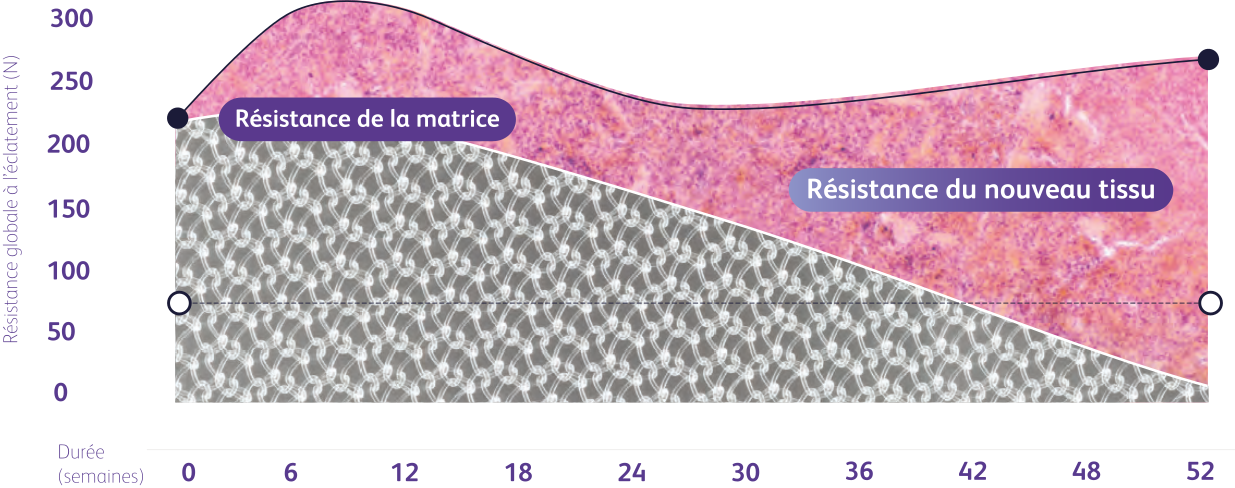
• Fournit un soutien immédiat lors de la chirurgie et favorise la guérison et la stabilité grâce à une intégration rapide.11-14,24
• Une intégration tissulaire > 75% à deux semaines a été démontrée dans des études précliniques.18
• Les études précliniques démontrent que le P4HB favorise la production de nouveau collagène et est remplacé progressivement par le tissu du patient.11,12,24
• Stimule la maturation du collagène de type III vers du collagène de type I.11,12
• Le collagène mature (c’est‑à‑dire le collagène de type I) est prédominant à 7 mois.11
Soutien à long terme
• Génère un tissu 3 à 4 fois plus résistant que le tissu natif.11,12,24
• Les études cliniques ont montré que la matrice GalaFLEX™ soutient et stabilise la position à long terme du pôle inférieur et du sillon sous‑mammaire (IMF) lors des interventions.25,26,27
Résistance de la réparation sur le long terme dans un modèle préclinique11-12-24
fois plus résistant
que le tissu natif28-31
Références:
10. GalaFLEX Scaffold Instructions For Use.
11. Preclinical data on file. Results may not correlate to clinical outcomes.
12. Deeken CR, Matthews BD. Characterization of the Mechanical Strength, Resorption Properties, and Histologic Characteristics of a Fully Absorbable Material (Poly-4-hydroxybutyrate-PHASIX Mesh) in a Porcine Model of Hernia Repair. ISRN Surg. 2013;2013:238067. Published 2013 May 28. doi:10.1155/2013/238067.
13. Martin DP, Williams SF. Medical applications of poly-4-hydroxybutyrate: a strong flexible absorbable biomaterial. Biochem Eng J. 2003;16(2):97-105.
14. Williams SF, Martin DP, Moses AC. The History of GalaFLEX P4HB Scaffold. Aesthet Surg J. 2016 Nov;36(suppl 2):S33-S42. doi: 10.1093/asj/sjw141.
15. No scaffold is indicated for use in contaminated or infected wounds.
16. Pineda Molina C, Giglio R, Gandhi RM, Sicari BM, Londono R, Hussey GS, et al. Comparison of the host macrophage response to synthetic and biologic surgical meshes used for ventral hernia repair. J Immunol Regen Med. 2019;3:13–25.
17. Halaweish I, Harth K, Broome AM, Voskerician G, Jacobs MR, Rosen MJ. Voskerician G, Jacobs MR, Rosen MJ. Novel in vitro model for assessing susceptibility of synthetic hernia repair meshes to Staphylococcus aureus infection using green fluorescent protein-labeled bacteria and modern imaging techniques. Surg Infect (Larchmt). 2010;11(5):449-454. doi:10.1089/sur.2009.048.
18. Nguyen, Phuoc T., et al. “Influence of a New Monofilament Polyester Mesh on Inflammation and Matrix Remodeling.” Journal of Investigative Surgery, vol. 25, no. 5, Sept. 2012, pp. 330-339. EBSCOhost, doi:10.3109/089L1939.2011.639848.
19. Klinge U, Junge K, Spellerberg B, Piroth C, Klosterhalfen B, Schumpelick V. Do multifilament alloplastic meshes increase the infection rate? Analysis of the polymeric surface, the bacteria adherence, and the in vivo consequences in a rat model. J Biomed Mater Res. 2002;63(6):765-771. doi:10.1002/jbm.10449.
20. Engelsman AF, van der Mei HC, Ploeg RJ, Busscher HJ. The phenomenon of infection with abdominal wall reconstruction.” Biomaterials. 2007;28(14), 2314-2327.
21. Thornton, M. Julie. “Estrogens and Aging Skin.” Dermato-Endocrinology, vol. 5, no. 2, 2013, pp. 264–270., doi:10.4161/derm.23872.
22. Pineda Molina C, Hussey GS, Liu A, Eriksson J, D’Angelo WA, Badylak SF. Role of 4-hydroxybutyrate in increased resistance to surgical site infections associated with surgical meshes. Biomaterials. 2021;267:120493.
23. Pineda Molina C, Hussey GS, Eriksson J, et al. L-Hydroxybutyrate Promotes Endogenous Antimicrobial Peptide Expression in Macrophages. Tissue Eng Part A. 2019;25(9-10):693-706. doi:10.1089/ten.TEA.2018.0377.
24. Scott JR, Deeken CR, Martindale RG, Rosen MJ. Evaluation of a fully absorbable poly-4-hydroxybutyrate/absorbable barrier composite mesh in a porcine model of ventral hernia repair. Surg Endosc. 2016;30(9):3691-3701.
25. Mallucci P, Bistoni G. Experience and Indications for the Use of the PLHB Scaffold (GalaFLEX) in Aesthetic Breast Surgery: A 100-Case Experience. Aesthet Surg J. 2022;42(12):1394-1405.
26. Adams WP Jr, Baxter R, Glicksman C, Mast BA, Tantillo M, Van Natta BW. The Use of Poly-L-Hydroxybutyrate (P4HB) Scaffold in the Ptotic Breast: A Multicenter Clinical Study. Aesthet Surg J. 2018;38(5):502-518.
27. Bistoni G, Sofo F, Cagli B, Buccheri EM, Mallucci P. Artificial Intelligence, Genuine Outcome: Analysis of 72 Consecutive Cases of Subfascial Augmentation Mastopexy With Smooth Round Implants Supported by P4HB Scaffold. Aesthet Surg J. Published online May 14, 2024.
28. Choi JW, Kwon SH, Huh CH, Park KC, Youn SW. The influences of skin visco-elasticity, hydration level and aging on the formation of wrinkles: a comprehensive and objective approach. Skin Res Technol. 2013;19(1):e349-e355.
29. Vera, Martin. “Phases of Wound Healing: The Breakdown.” Wound Source. Accessed on Nov 13, 2020.
30. Levenson SM, Geever EF, Crowley LV, Oates JF 3rd, Berard CW, Rosen H. The Healing of Rat Skin Wounds. Ann Surg. 1965;161(2):293–308.
31. Engelsman AF, van der Mei HC, Ploeg RJ, Busscher HJ. The phenomenon of infection with abdominal wall reconstruction.” Biomaterials. 2007;28(14), 2314-2327.